Neoplasm Vs Disorder: Does it really make a difference?

This has come up several times in the different message boards I have participated in over the years: Do we have cancer, or not? (Please note: the factual information in paragraph 3 was gathered for this article – http://www.ncbi.nlm.nih.gov/pubmed/19472396?dopt=Abstract – The opinions expressed throughout, however are my own. Please feel free to leave comments with your take on this subject!)

When you look up the word “Neoplasm” on the internet (an activity during which extreme caution should ALWAYS BE EXERCISED), the first choices that come up are “NCI Dictionary of Cancer Terms”, and “Characteristics of malignant neoplasms”, among others. People see “Cancer” and “malignant” and immediately get scared. Here’s the thing though…Myeloproliferative Neoplasms, MPNs, prior to 2008, were Myeloproliferative DISORDERS, or MPDs. 

What exactly happened in 2008 to so drastically change the very existence of these diseases? Well…the World Health Organization reclassified them. Yep, That’s all. In 1951 When William Damashek described the disorders; he included CML, PV, ET and PMF in the group. At this time they were classified as Disorders. In 2001 the WHO gave them a broader heading of Chronic Myeloproliferative Diseases (CMPD), and included chronic neutrophilic leukemia, chronic eosinophilic leukemia/hypereosinophilic syndrome (CEL/HES), and “CMPD, unclassifiable”. Then in 2008 the WHO reclassified things a bit again. The term CMPD was just replaced by Myeloproliferative Neoplasm, or MPN.

You didn’t suddenly go from NOT having cancer, to HAVING cancer…the disease in itself, the proliferation of cells that do not belong where they are, is the fundamental meaning of “cancer”. The very definition of cancer is the uncontrolled growth of abnormal cells in the body. Our little family of diseases fits pretty well in that group when you look at it that way, doesn’t it?

I like to think of it as trying to organize your sock drawer. You have white socks, black socks, red socks, blue socks, those are easy to organize. But what about the multi-colored argyle socks? Where do you put those. Or the red white and blue striped socks? Or the holiday themed socks? How do you classify things that fit so many different headings? You use broader definitions. This is just what makes sense in my goofy mind. 

I know that cancer is a scary word, but you could call it a disorder, a neoplasm, a disease, or Fred, if it makes you feel better, It will not change the fundamental nature of your disease. What matters is how you approach it. As long as you are approaching your situation assertively, and proactively, and educate yourself as well as possible, the classification of the disease shouldn’t mean much.

 As always, you are your own best advocate. If you do not take care of yourself, who will?

Until next time,

Lina

Out of curiosity

Hello there all 🙂 

Little update and a question…

Update – I’m feeling much better, still icing my backside off and on. Bruised, and sore. But feeling better. Now I’m just starting to stress out about the results of the test. But hopefully they’ll come through soon. I’ll let you know what they are as soon as I hear 🙂

Now for the question: I’m thinking about doing the Video Blog and posting to youtube. I would ask for subjects here, and then record a video and post it to my youtube channel. Would anyone have any interest in that? I would still write here for the most part, but an occasional video post might be interesting. I’ll set up a poll, but please leave a comment with your opinion, and also suggestions for a topic you’d like discussed 🙂

Thanks all!

As always, you are your own best advocate. If you do not take care of yourself, who will?

Until next time,

Lina.

Bone Marrow Biopsy

I’m home, resting, but just wanted to post these videos. If you’re squeamish, I’d recommend not watching. The video is in 2 parts. My husband recorded this for me. Part One and Part Two.


Nap time now

Remember, you are your own best advocate. If you do not take care of yourself, who will?

Until next time,

Lina

To ease my anxious brain…

I’ve been thinking too much about the biopsy on Friday, and making myself nervous. I’m the kind of person who feels more comfortable with situations when I fully understand them, or can explain them fully to someone else – so please bare with me while I do that now with regard to bone marrow biopsies/aspirations 🙂

A bone marrow biopsy is used as diagnostic criteria for blood, and or bone marrow diseases, and some cancers. Typically the sample will be drawn from either the pelvic, or the breast bone.

The bone marrow aspiration is typically performed before the biopsy is done. This is performed by inserting a needle into the bone, and using a syringe to withdraw some liquid marrow. Another needle will be used for the biopsy portion of the event.

The biopsy itself involves the removal of the solid portion of bone marrow. This is done using a larger gauge needle. Once the large needle has been inserted into the bone, the center of the needle is removed, and the hollowed portion is pushed deeper into the bone. This hollow section of needle is what captures the sample of core, or marrow required for testing. 

A wide variety of diseases can be diagnosed using these tests, including but not limited to a plethora of types of leukemia, or lymphoma, multiple myeloma, my personal favorite (just kidding…) essential thrombocytosis, myelofibrosis (What we’re on the lookout for) and myelodysplastic syndrome. 

Now, here’s where I start getting amused. The information I’m using for source material (which I will cite at the end of this article, I promise) was undoubtedly written by someone who has never experienced this test. Under the “How the test will feel” section…they say “you MAY feel a brief, sharp pain when the liquid (aspirate) is removed”…to me that was kind of like when the gynecologist says “Now just a little pressure now…” (my gynecologist is a guy…pretty sure he doesn’t actually have a clue what a speculum feels like…) but back to the subject….As someone who has had this done without anesthetic, I can assure you it was NOT brief. It was a LONG sharp pain, which seemed to radiate down my legs, and up my spine.

Thankfully I will be receiving some anesthesia/pain relief for this test. OK…I’ll end now with this little info picture for anyone who may be curious about the anatomy of your bone marrow 🙂81

Information for this article was gathered here  and here


As always, you are your own best advocate. If you do not take care of yourself, who will?

Until next time, 

Lina


Upcoming adventure…

So I had an appointment with my hem/onc this past Wednesday (8/20). As is customary at these appointments, the physical exam was performed by a med student. Pretty sure that other than the handshakes at the beginning and end of the appointment that my doc has not touched me once in the 8 years I’ve been seeing him. Is that what it’s like for you guys too? Just curious 🙂

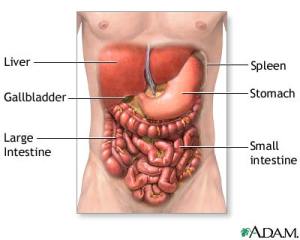
Anywho…after listening to my heart and lungs, he decided it was time to poke around my abdomen. He lifted up my shirt, and just sort of stared at my belly for a bit. I think I mentioned before that the ribs on the left side are pretty distended/misshapen, presumably because of the size of my spleen. But this guy was surprised by that. As he starts poking around he’s trying hard to find the end of my spleen…he finally seemed satisfied that he had found it. Down by my navel…Now for those who may be unfamiliar with where ones spleen normally should be……The spleen is on the upper left side of your abdomen. Generally completely housed by your rib cage. See image below…

Spleen
http://health.kernan.org/presentations/100049.htm

As he was poking around trying to find it, he seemed very surprised that it was as large as it is. How do I know? He muttered “holy shit” under his breath…soo yeah. Fairly indicative of surprise, I’d say. 

After he was done with the physical exam, he went and conferred with my doc. When he came in, we exchanged the usual pleasantries. He asked how I am, how’s work, how’s my husband etc etc. Then he starts in with “So how are you feeling…?”. At which point I pulled out The Infamous Binder, flipped to my “new/recurring symptoms” section. There is a lovely long list of things – Headaches, fatigue of course at the top, but also Night sweats, itching, fevers, body aches, bone and join pain etc etc. And as I’m reading off my list, I can tell he’s thinking about what he’s going to say, so I finished my list with “And I think that it might be a really good idea to get a new biopsy done, since all these changes, plus the lowering blood counts seem to be indicative of something new”. And he just nodded, and said he felt that was the best course of action. If nothing else we’ll get a new baseline. PLUS we’ll get the results of the genetic testing that I’ve been curious about for so long 🙂

So, this Friday (8/29) I’ll be going in for my 2nd bone marrow biopsy. I WILL get some sedation for this, thankfully. The first one I ever had was pretty awful. Just a local to numb the skin…nothing more. That was not cool. We should get the results by the following Friday.

I’m thinking about attempting to either tweet or blog DURING the biopsy (if they allow it, and if I’m not too goofy…) We’ll see how that goes. M will be there, and has agreed to take pictures for me. I’m one of those weirdos who is REALLY intrigued by medical procedures, especially when they are being done to me. 

But that is enough rambling from me for now.

You are your own best advocate, if you do not take care of yourself, who will?

Until next time,

Lina

Migraine – Question for MPN patients

So today is the 3rd day of a terrible migraine. Started with visual aura as always – picture the fractals of a broken mirror, and brightly colored, chaser style Christmas lights along the edges of each. This typically takes over my vision entirely. Starts out small, then increases to the point of not being able to see at all. After that my peripheral vision is usually gone for the rest of the day, on whichever side the aura started. Wednesday it started on the right, so my right side peripheral vision was gone the rest of the day. Which made driving home from work quite the (ill advised) adventure. I did go to work Thursday morning, but by 10 AM I couldn’t take it. The pain was really bad. Now I have a pretty darn high pain tolerance, so when I say it hurts, I mean to the point of being in tears, hurts. Thankfully I have a very wonderful boss, who could see how miserable I was and let me go home. I got home yesterday, slept pretty much all afternoon, the short spans during which I was awake, were very painful, spent mostly either crying or vomiting. The pain was (still is) terrible. One of the worst migraines I can remember having. The last one that was this bad, I was still living at home, and my mom actually took me to the E.R. 

I finally broke down and took a vicodin in hopes that it would help. All it really succeeded in doing is making me feel really dumb. Migraines make me stupid to begin with, add something like that and I’m totally useless. 

So now, getting to the point – My question for ET patients specifically – Do you all have migraines like this? Is this an ET thing?

Off to bed for now.

You are your own best advocate, if you don’t take care of yourself, who will?

 Until next time,

Lina
FINALLY!

Just a quick little blog for right now…

I finally heard back from the NP at my Hem/Onc’s office. She agrees that it is probably time for another BMB. She hadn’t realized it has been 9 years since the last one. As for the way I’ve been feeling, she didn’t really have a whole lot to say on that. My next appointment is 8/20, so I’ll talk to the doc about it all, and pick his brain for a while. At the same appointment we’re going to schedule the BMB.

I also spoke with her about getting tested for the CAL-R mutation, so she is going to put in the order for me for my appointment in August. I’m pretty curious to see the results of that. 

Are any of you CAL-R positive?

What about Jak2?

Remember to be assertive!

As always, you are your own best advocate. If you do not take care of yourself, who will?

Until next time,

Lina

Mind/Body Techniques and Something Hard to Define…

I promised you the “mind/body” techniques, and I will post them for you at the end of this. But for now I just needed to do a quick bit of rambling. So over the last several weeks my blood counts have been dropping, and I just haven’t felt “right”. Do you know that feeling? Where you can tell that something isn’t as it should be, bit you don’t know what that something actually is? This last week for example, Monday started with a migraine. Not completely out of the ordinary. I get migraines fairly frequently. But the rest of the week continued getting stranger. Wednesday I was so dizzy and nauseated I could barely see, I had to leave work. (driving home was quite the adventure :-\)I was too weak/tired to get off the couch or out of bed the rest of the day. The rest of the week I felt basically the same way. I have been very tired, disoriented and weak. I’m tired to the point of being unable to function normally. Just feel like I’m blundering around stupidly. Which will hopefully explain the disorganization of the previous paragraph. Please forgive me. On to the original purpose of this post…

Below are the techniques shown to us at the NORD MPN Meeting in San Antonio by Sharon Cohan of the Leukemia Lymphoma Society. I urge you to try them when you’re feeling stressed or sick. I’ve been trying the relaxation breathing off and on today, and it really has been helping a bit.


  • Mind-body techniques are coping strategies that work well for many people 
    with chronic illnesses, including cancer. 
  • These techniques have a number of potential benefits.
  • They reduce stress and help to restore a sense of control over both your body and your emotions.
  • They can help relieve or reduce distressing symptoms, including pain, 
    anxiety, and nausea.
  • They can be done whenever and wherever you want to do them. Once you learn them, they belong to you.
  • There are several mind-body techniques you can learn.  You can choose the ones that feel
    right for you.  We have already practiced 2 of them during this workshop.
  • Deep breathing, the first technique we practiced, is designed to help promote relaxation and focus the mind.
  • With progressive muscle relaxation, you tighten and then relax various muscle groups, one by one, until your entire body is relaxed.
  • Meditation is a technique that requires you to focus your attention inward.  You concentrate on your breathing and on the present moment.  We practiced special-word, or mantra, meditation earlier.  There are other forms of meditation as well.
  • Guided imagery involves creating a peaceful, pleasant picture or image of a place in your mind, where you can go to distract yourself from unpleasant or anxiety-producing situations.

<<MIND-BODY TECHNIQUE: RELAXATION BREATHING>>

Before we go on, let’s take a moment to breathe slowly and relax using a special technique.

You use it any time you feel you need it.

  • Close your eyes. Take a breath in while counting to 1; then let the breath out while counting to 1. (Breathe in: 1.  Breathe out: 1.)
  • Take a slightly deeper breath while counting to 2; then breathe out while counting to 2. 
    (Breathe in: 1, 2.  Breathe out: 1, 2.)
  • Now breathe in to the count of 3; breathe out to the count of 3. 
    (Breathe in: 1, 2, 3. Breathe out: 1, 2, 3.)
  • Now take a deeper breath in to the count of 4; breathe out to the count of 4.
    (Breathe in: 1, 2, 3, 4.  Breathe out: 1, 2, 3, 4.)
  • Next take a breath in while counting to 5; let the breath out to the count of 5. 
    (Breathe in: 1, 2, 3, 4, 5.  Breathe out: 1, 2, 3, 4, 5.)
  • Now work backward, starting with 5 counts, then 4, then 3, then 2, then 1:

–       Breathe in: 1, 2, 3, 4, 5.  Breathe out: 1, 2, 3, 4, 5.

–       Breathe in: 1, 2, 3, 4.  Breathe out: 1, 2, 3, 4.

–       Breathe in: 1, 2, 3.  Breathe out: 1, 2, 3.

–       Breathe in: 1, 2.  Breathe out: 1, 2.

–       Breathe in: 1.  Breathe out: 1.

  • Sit quietly for a few minutes and let your breathing return to normal. 

MIND-BODY TECHNIQUE: SPECIAL-WORD MEDITATION>>

  • Let’s pause for a moment to relax.  This is a relaxation method called 
    special-word meditation, or mantra meditation.
  • First, choose your special word.  It should be a simple word or phrase 
    that has some relaxing or comforting meaning for you.  Examples include “peace,” “tranquil,” or “I am at peace.”
  • Close your eyes.  Breathe in deeply.  Then let the breath out slowly.  
    Repeat this 2 more times.
  • Start to repeat your special word silently to yourself.  Continue to breathe slowly.  Say the word to yourself as you breathe in.  Then say it as you 
    breathe out.
  • If stray thoughts come into your mind, just turn your attention back to your special word and continue to repeat it to yourself as you breathe.
  • When it is time to end the meditation, take a deep breath in and let it out slowly.  Breathe in and out one more time.  Then slowly open your eyes.

<<MIND-BODY TECHNIQUE: Guided Imagery>>

  • We can take a moment to practice a guided-imagery exercise now.

–       Close your eyes.  Think about where you would like your peaceful place to be. Maybe it’s a beach at sunrise.  Maybe you’re floating on a lake or sitting on a blanket in the woods.  As you picture your special place, continue to breathe naturally.  Picture as much detail about your place as possible

q What do you see around you?

q What do you smell?

q What do you hear?  Do you hear the breeze?   The ocean?  
Are birds singing?  Pay attention to the sounds.

q How do you feel in this special place?  Remember that feeling.

–       Sit quietly in your place for a while

<<Facilitator:  Allow the group to sit quietly for a couple of minutes.  Then end the exercise.>>

–       When you are ready to leave, take a deep breath in and let it out slowly.  
Open your eyes


As always, you are your own best advocate. If you do not take care of yourself, who will?

Until next time,

Lina

OVAC Lobby Day Review

OVAC Lobby Day: 7/7-7/8

This may be a little haphazard, but I’ll try to keep it somewhat organized.

The OVAC Lobby Days took place Monday July 7th and Tuesday July 8th. This is the first time I’ve done any type of lobbying, and was therefore an overwhelming, educational, terrifying, overall exhilarating experience.

OVAC, One Voice Against Cancer is a collaboration of non-profit organizations working together to try to find cures for cancer. OVAC has representatives from all across the country, every walk of life, all cancers. We all spoke of our personal experiences, which are very different, but our goal was the same, so we truly were speaking against cancer with One Voice. There’s something oddly uniting about the subject of cancer. We all know someone who has been touched by it in some way. Each of us at the event had our own personal connection to cancer. That is what brought us together.

Monday started with registration, and for me, a sort of awkward wandering around in the lobby until a few of us got to talking. The ladies I befriended in the lobby each shared their own personal stories. One of the ladies told me about her mother who had bladder cancer. Luckily she had responded to treatment, and is doing quite well now, but the experience is what inspired her to become an activist for BCAN (Bladder Cancer Advocacy Network)The other young lady I had the privilege to meet had very recently lost her sister to brain cancer. The pain was still so visibly fresh for her, and I admire her so much for having the strength to join the Brain Tumor association and tell her sister’s story.

After getting to know one another we went in to begin our training. https://www.flickr.com/photos/96126987@N00/14654799465/in/set-72157645186462238There were 88 participants from 30 states, and I’d say about 1/2 of us are newbies, so I was not completely alone 🙂 During training we were given 3 very specific goals, or asks; the end goal is of course making cancer research and prevention a top priority, thereby finding better treatment options, and hopefully cures. Specifically though we were asking for 1) $5.26 billion to be provided for the National Cancer Institute (NCI) 2) to ensure a proportional increase to NCI’s funding when there is an increase in the NIH’s funding, and 3) $510 million to be budgeted for the CDC Division of Cancer Prevention and Control.

These are pretty big things to be asking for, and pretty intimidating to be asking political leaders for them. But who else should we speak to other than the people with the power to help make the changes we are asking for? To speak to the decision makers, to tell them what their constituents want, and need; that is why we were there.

It was stressed to us during training that making a connection with the representative, congressperson, or staffer is a good way to start. Tell them where you’re from; down to the street or the neighborhood, then tell your story. Grab their attention; remind them where they are from. If you can make an emotional connection with them then tell them your story, then hopefully they will remember you better.

So with the goal of being remembered in mind, I plotted out a few ideas for the following day. Knowing that my nerves may get the better of me, I decided that it may be best for me to focus on the emotional aspect of our presentations. I’ve always been a nervous test-taker, and to me trying to remember the facts and figures felt very much like a test. I often get tongue tied when put on the spot, but I knew there were certain facts I knew I’d get right. I decided to focus on my story; when I was diagnosed, what my disease is, the treatment options available, and also the cost of said treatments.

I was in a very small delegation from my state. VERY. SMALL. There were only two of us. So our meetings were rather short. 20140712_140034We started the day on the senate side of the Capitol. 20140712_140114We met with a staffer from Senator McCaskill’s office, and from Senator Blunt’s office. After the meeting with Senator Blunt’s office, we had lunch, then headed over to the House side. 20140712_140123There we had a meeting with Ann Wagner (My state Representative) and a staffer from Sam Graves’ office (my fellow Missourian’s representative) All of the presentations on Tuesday, while brief were very meaningful.

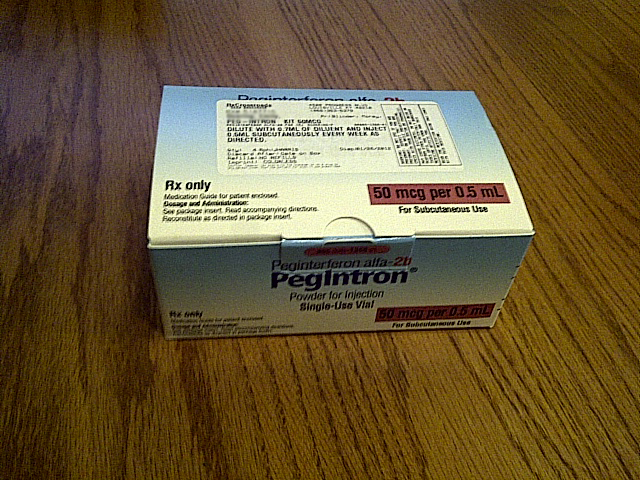
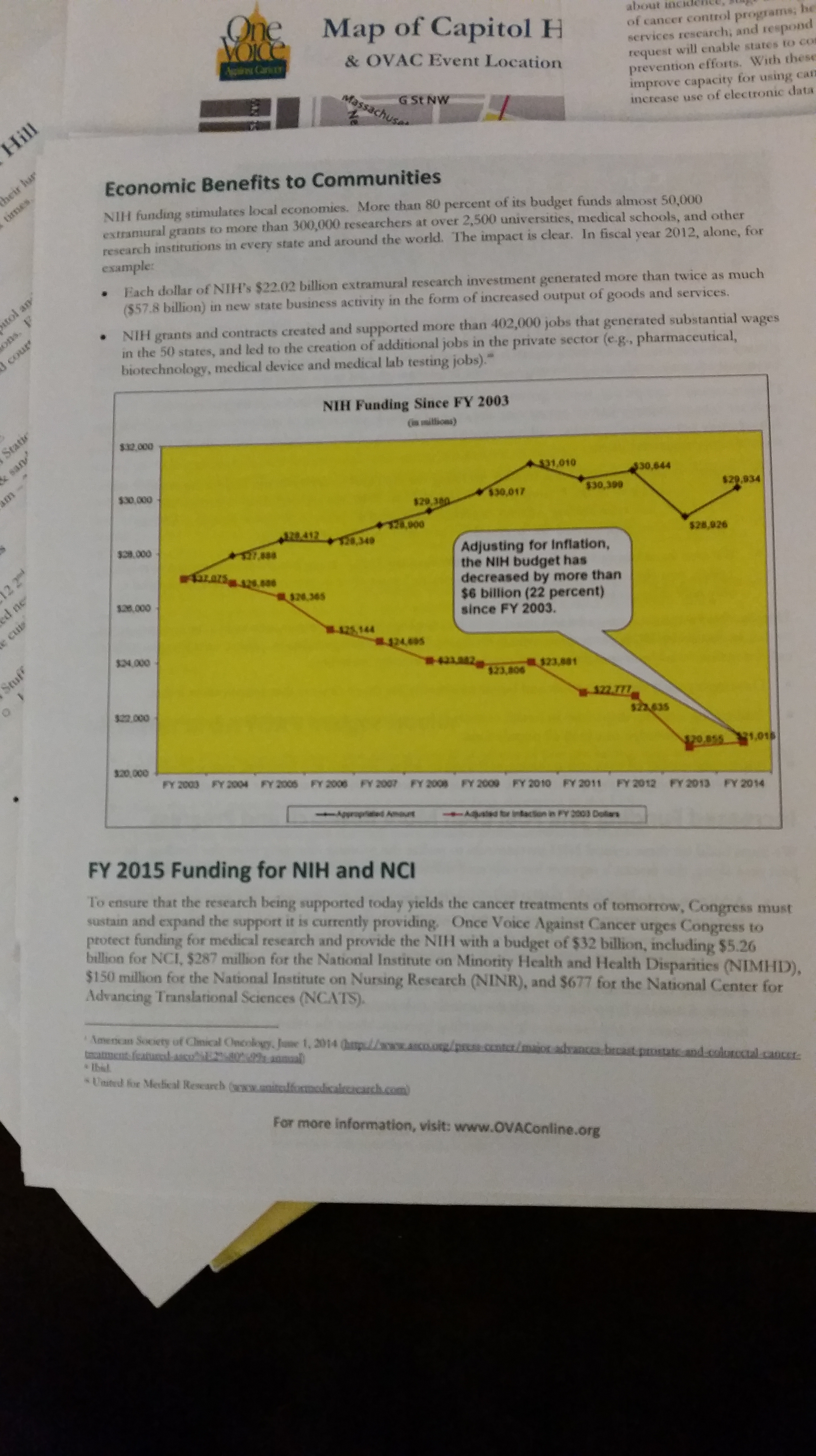
gravois-20120210-00130My favorite part of the presentation is when I would start telling them about PegIntron, the medication that I have had the most success with. At this point I would pull out the box of meds that I brought with me, place it on the table in front of me and say “This drug is not yet FDA approved for use in MPN patients. I have been denied 3 times by my insurance company on the grounds that my purposes are “off label”.  This box costs $2000. It contains ONE dose of medicine. I take this once a week. That’s $104,000 per year for however many years I’m lucky enough to remain alive.” That tended to leave a strong impression on the folks I was speaking to. And then I would start to work in the asks. “With better funding for research, better treatments could potentially be approved for patients. More accessible treatments, mean healthier, more productive constituents.”

 While I was the only person I know of that was there representing MPNs, I am hoping that my presentation was memorable, not just to our elected officials, but also to the other participants. Just about everyone I spoke to had never heard of MPNs. So I’d like to think that I helped educate some other members of the cancer community.

I’m realizing now that I’ve done an awful lot of rambling, so I will leave you for now 🙂 Tomorrow I’ll be posting the mind-body techniques I referenced in my last post!

As always, you are your own best advocate. If you do not take care of yourself, who will?

Until next time,

Lina

20140712_140334 20140712_13591720140708_134227 20140708_102511 20140712_140238

NORD MPN Patient Meeting, San Antonio, TX

Whew. So, that was quite an experience. Flew out last Friday afternoon, got in to San Antonio Friday night..the event was Saturday, and then I started writing this in the airport ready to fly home. (Then my fatigue really hit me, and I had to give up on the writing for a while. I needed a nap lol)

There were presentations given by Dr. Michael McDevvit of Johns Hopkins, two representatives (Sharon and Adriana)from the Leukemia Lymphoma Society and also from me.

Dr. McDevvit’s presentation as very informative. He talked a lot about clinical diagnostic criteria, and how you “know you’re in trouble when there are this many steps to a diagnosis”. SO TRUE. Since our diseases (ET, PV, MF)mimic one another, and also many other diseases, I guess it makes sense that they would have to add several other steps to the diagnostic criteria to ensure that they are actually diagnosing us correctly. And there is still no guarantee that will happen. It seems that we are misdiagnosed more commonly than we are diagnosed correctly.

Adriana, and Sharon, from LLS presented on the different functions of LLS. How they raise money, how they support patients, different support groups that are available, etc. They also taught us some mind body techniques to help with the stress, and the fatigue that can sometimes come our diseases. If anyone is interested in that, I will post them here 🙂 Let me know in the comments.

The following is my presentation (in full…not the truncated version I ended up delivering)


Hello there! I’m so glad to see so many of you here today! I’d like to start out by saying that if I appear

nervous, please forgive me. It’s only because I’m mildly terrified. (smile)

As they said, my name is Emily, but I usually go by the nick-name of LinaMPN on social media, and my

blog, so I’m more of a behind-the-scenes kind of girl, but I will do my best here today.

I am 27 years old, and I have Essential Thrombocytosis. I was officially diagnosed when I was 18

years old, after an initial misdiagnosis by my GP. I presented with fairly vague symptoms of fatigue,

headaches, and bruising. The fatigue, I was able to write off because I was 18, a freshman in college,

taking 18 credit hours that semester, working, and trying to maintain some semblance of a social life.

So it was pretty easy to pass off the fatigue as “overwork”. The headaches were also relatively easy

to ignore as a symptom, because I’ve had migraines since I was 10 years old. Headaches were not

unusual for me. But the bruising was harder to ignore. It seemed that just about every day a new,

large bruise was popping up somewhere. Normally if you have a bruise the size of a softball on your

belly, or your arm, you know where it came from, or how you got it, but these bruises just seemed to

randomly appear. After visiting my GP with those symptoms, she felt it would be best to draw some

labs. Somehow my platelet count came out as 13,000, which led to an incorrect diagnosis of Idiopathic

Thrombocytopenic Purpura, or ITP. My GP decided to prescribe me steroids, and play that watch and

wait game for a while. After a brief stint on prednisone my GP decided we should draw another CBC.

As it turned out, my platelets were actually 2.6 million. When we discovered this, my GP immediately

stopped my prednisone regimen (YAY!), admitted that I was far too weird for her to treat, and referred

me to a Hematologist.

This hematologist decided that it would be best to do a bone marrow biopsy (everyone’s favorite event,

I’m sure…) and the results confirmed ET. After diagnosis, and much discussion my hematologist decided

that it would be best to begin taking Anagrelide. How many of you have taken Anagrelide? And how

many of you had issues tolerating Anagrelide? I’m one of those people who did NOT tolerate Anagrelide

well; headaches, heart palpitations, dizziness, shaking. It did not help that the hematologist I was

seeing had never treated an MPN of any variety before. What helped even less was that he was a fan of

changing the dosage of my Anagrelide every. Single. Week. The higher the dose, the worse the side effects, and

unfortunately no matter what the dosage, we never did see the corresponding drop in blood counts that

we were hoping for.

At this point my family and I determined it might be best to try a different doctor. My mother was

undergoing treatment for breast cancer at the same time this was happening, and so she asked her

oncologist if he had any recommendations, which led me to my current oncologist.

My new oncologist determined that Hydrea would probably be a better fit for me, so we began at a

relatively low dose. But we found that it took 2 grams per day before we finally saw an effect on my

platelets. Unfortunately it also caused a HUGE drop in all the rest of my blood counts as well, so we had

to discontinue it for quite a while.

Being a young/tech savvy patient, I spent a lot of time researching alternative treatments. I had heard

that a lot of other patients were having a lot of success with Interferon, and I very much wanted the

chance to try it.

My doctor is fairly conservative though, and had never treated a patient with it before. It took several

months of pushing, and pleading, and darn near begging, before the doctor would agree to it. Even after

he agreed though, we still had to deal with the insurance company. The use of PegIntron, which was

the chosen version of the medication, is not approved by the FDA for the treatment of MPNs. I had to

appeal to my insurance company three times to see if they would allow the off label use to be covered

under my policy, and unfortunately, that answer was no. Luckily though, I was able to get my meds

directly thru the drug company, through a patient support program they offer.

I was on PegIntron for 2 years, until this past March when I had some complications that we later

found were unrelated to the treatment. Oddly enough, my counts are continuing to go down, even off

treatment, so for now we are on “watch and wait” until my next CBC in July. If my counts continue their

downward trend, then it might be time for another bone marrow biopsy.

That’s more than enough about me, let’s talk about the group I’m here to represent. I am here on behalf

of the MPN Research Foundation. They were founded in the year 2000 by a group of patients who were

very disappointed by the lack of available information and the lack of research that seemed to be taking

place for MPNs. Hoping to change that for other patients, the MPN Research Foundation was born.

Since this group was founded by patients, you can be certain that their goals are the same as yours;

The main goal, is finding a cure. The MPN Research Foundation only funds projects relevant to PV, ET

and MF, and the terms of each grant are negotiated to make sure they maximize the money invested

in actual research. To date, The MPN Research Foundation has awarded approximately nine million

dollars for MPN research. In the year 2014 alone they have One Million Dollars in grants planned. While

their main goal is to further research, they also want to support patients in as many ways as they can,

particularly thru partnerships with groups like NORD.

They connect patients with doctors. They connect patients with research studies, with support groups

– most importantly, to me at least, they connect patients with each other! I don’t know about the rest

of you, but when I was diagnosed, I felt extremely isolated. There was no one that I could talk to that

really understood what I was going through. Now don’t get me wrong, I have an extremely supportive,

wonderful family, and great friends, but the blank stares when I would try to explain how I was feeling

were not terribly reassuring. It wasn’t until I stumbled upon the MPN Research Foundation and was

connected with their patient support groups that I felt that I was no longer alone. From the very first

meeting I attended in 2011, my entire perspective on my disease changed. Just knowing that there were

people out there who were working to change the way that people understand MPNs, and that are

working to help find a cure made me feel so much better, and inspired me to become a more proactive,

empowered patient.

The best things that you can do for yourself are to get educated, and to be proactive! Learn as much as

you can about the latest research and treatment options. Take your knowledge and share it with family

and friends! Become an MPN activist, and join the MPN Research Foundation in pushing MPN Science

closer to better treatments, and hopefully a cure for our diseases!

To find out more, I strongly recommend that you take some time out to look at the website. There you

can sign up for their newsletter, and see the latest news, research, and information on events you can

attend.

As always you are your own best advocate. If you do not take care of yourself, who will?

Thank you very much


Next up on the agenda is Washington D.C. for the OVAC Lobby Days! I’ll be there on 7/7-7/8. I’m excited and nervous. Mostly excited. I’ll update as I am able, and hopefully we will see a good positive outcome!

As always, you are your own best advocate, if you do not take care of yourself, who will?

Until next time,

Lina