Blood Cancer Awareness Post 15: Essential Thrombocytosis

Yesterday we talked about PV, today on to the MPN closest to my heart, ET. (Below, is another repost from earlier.)

What IS ET?

Essential (or primary) Thrombocytosis

Essential (or Primary) – Meaning the disease is not secondary to another problem.

Thrombocytosis(Made up of 3 words) Thrombos – meaning lump or clot –

Kytos – meaning cell

And Osis – meaning condition

To sum that up: A condition in which you have too many thrombocytes (aka platelets) in your blood stream.

ET affects mainly the platelets, or clotting factor in your blood. This can lead to a variety of different issues and symptoms including, but not limited to headaches(migraines), dizziness, abdominal pain(due to enlarged spleen or possibly liver) increased risk of blood clots, and stroke, and visual changes or disturbances.

As I have said in the issue before, each of these MPNs can be very difficult to diagnose, as the symptoms can be difficult to pinpoint, and often lend themselves easily to a variety of diseases. I think I will go through and answer the same some of the same questions as in the first entry, applying them to ET.

How are you diagnosed with that disease/condition/thing?

How do they treat it?

When will it be cured?

As with most MPNs, ET can often be discovered after some other event/illness/diagnosis. Regardless of how the disease is initially discovered, there are several criteria that must be present to help verify which MPN you are dealing with. Most commonly diagnosis happens after a series of blood tests; Complete Blood Count (CBC), Comprehensive Metabolic Panel (CMP), and often Bone Marrow Biopsy (BMB – this is necessary for ET diagnosis). What the doctor is looking for in a CBC is an abnormal increase in platelet counts. (The normal amount of platelets for people to have in their system is 150,000-450,000 so above that is considered abnormal, and docs will probably want to look further) There are several things that can cause high platelets though…infections, trauma, surgeries etc…so a repeat CBC is often tried first, and then a BMB is usually had (At least this is how it was with me). With a BMB your doctor will be looking at bone marrow abnormalities and genetic markers in the marrow.

Treatment for ET varies by patient. Treatment ranges from watch and wait, or pheresis, to prescription medications like Pegylated Interferon, Hydroxyurea or Anagrelide(More common for ET patients, but PV can take it as well). Pheresis is the process of filtering the blood, basically. You get hooked up to two IV lines, one out, one in, and your blood is sent thru a centrifuge, the excess platelets are spun off, and then the rest of your blood is given back to you.

As for a cure, this is the same as with any MPN. There is no “cure” per se (other than a bone marrow/stem cell transplant…but that is only done for MF patients at this point). The disease can be managed thru treatment, and one can live a normal life with little to no interference from the disease.

I do not claim to know all there is to know about ANY myeloproliferative neoplasm for that matter…. I am sure that I missed something here, but this is just my general understanding, and the way I would explain it to someone who knew nothing about ET. I would like to take this opportunity to invite ET patients to add to this. Particularly things like “What do you wish you had known at diagnosis that no one told you?”

*Note: I have a migraine at the moment and can barely see…so please forgive any typos that may be present. Also…depending on how long it lasts, I may not get tomorrow’s blog out on time! Please be patient with me!

If the migraine does clear up, tomorrow’s article will be about Myelofibrosis (MF)

Until (hopefully) tomorrow,

Lina

Blood Cancer Awareness Post 14: Polycythemia Vera

Yesterday we started talking about MPNs, just a general overview. Today we will be talking about Polycthemia Vera, or PV. This is again a re-post from earlier.

What is PV?

You may remember in my last issue regarding MPNs as a whole, over the next few weeks I plan on breaking down each of the 3 main MPNs (PV, ET, and MF).

 I will start with Polycythemia Vera(we will be addressing Primary Polycythemia).

PolyCythemia Vera

Poly-Greek for many

Cythemia(Made up of 2 words) Kytos – Greek word meaning Cell and

Haima – Greek word meaning Blood.

Vera – From the word Verus, meaning true.

To sum that up: Many blood cells floating around in the blood stream.

PV affects all of the hematopoietic bone marrow elements, meaning all the blood cells produced in the marrow are increased. This can lead to a variety of different issues and symptoms including, but not limited to headaches, itching(unique to PV), dizziness, abdominal pain(due to enlarged spleen or possibly liver) increased risk of blood clots, and stroke.

As I said in the issue before, each of these MPNs can be very difficult to diagnose, as the symptoms can be difficult to pinpoint, and often lend themselves easily to a variety of diseases. I think I will go through and answer the same some of the same questions as in the first entry, applying them to PV.

How are you diagnosed with that disease/condition/thing?

How do they treat it?

When will it be cured?

As with most MPNs, PV can often be discovered after some other event/illness/diagnosis. Regardless of how the disease is initially discovered, there are several criteria that must be present to help verify which MPN you are dealing with. Most commonly diagnosis happens after a series of blood tests; Complete Blood Count (CBC), Comprehensive Metabolic Panel (CMP), and often Bone Marrow Biopsy (BMB). What the doctor is looking for in aCBCis an abnormal increase in blood cell amounts. Red cells, white cells, platelets, everything. With a BMB your doctor will be looking at bone marrow abnormalities and genetic markers in the marrow.

Treatment for PV varies by patient. Treatment ranges from watch and wait, or phlebotomy, to prescription medications like Hydroxyurea or Anagrelide(More common for ET patients, but  PV can take it as well). Phlebotomy is basically blood letting. When counts get too high, a patient will go to the clinic, and a unit or so of blood will be removed from their body, thus lowering blood counts.

As for a cure, this is the same as with any MPN. There is no “cure” per se. The disease can be managed thru treatment, and some can live a relatively normal life with little to no interference from the disease. However, since every patient is different, everyone will experience a different set of symptoms of the disease.

I do not claim to know all there is to know about ANY myeloproliferative neoplasm for that matter…. I am sure that I missed something here, but this is just my general understanding, and the way I would explain it to someone who knew nothing about PV. I would like to take this opportunity to invite PV patients to add to this. Particularly things like “What do you wish you had known at diagnosis that no one told you?”

Tomorrow we will be talking about Essential Thrombocytosis (ET)

Until tomorrow,

Lina

Blood Cancer Awareness Post 13: MPNs

So far we’ve talked about our blood, it’s parts and functions, leukemia, lymphoma and myeloma. Today we will start covering Myeloproliferative Neoplasms.  (No, you’re not having deja vu…the post below is a re-post from earlier in my blog)

I have been asked what exactly an MPN is by many people: friends, family, co-workers random strangers at the doctor’s office(so, what are YOU in for…?)… and I have struggled over the years with finding a good way to explain it. I have come up with a couple of silly analogies about a factory going haywire and I also dabble with the more technical explanations from time to time…but that tends to leave me with blank stares… or they smile and nod along with me, meanwhile I can see the information going in one ear and out the other……

In this first of four articles, I am going to try to find concise ways to explain MPNs as a whole. In the subsequent entries I will try to do the same for each ET, PV and MF.

SO…here goes.

If we break down the words they give a pretty good working definition.

Myeloproliferative Neoplasm:

Myelo -From the Greek Muelos which means marrow

Proliferative/Proliferation -to grow or multiply by rapidly producing new tissue

Neoplasm – an abnormal growth of body tissue

So basically…the bone marrow produces lots and lots of cells that do not belong there. That is my basic working definition of a Myeloproliferative Neoplasm. It’s simple, not very technical, and it doesn’t tend to leave people’s eyes glazed over. For a lot of people, that is a fine answer, and they don’t need to know anything else.

Others want to know more, though. How did you find out about/were diagnosed with that disease/condition/thing, “is it …you know….(whisper)cancer?”, how do they treat it, when will it be cured, etc etc….Come to think of it…those are all questions that patients ask too. I have probably asked all of these questions a few times. I’ll try and answer these the way they were explained to me, and the way I understand them…so…these words might not make any sense whatsoever once they exit my head….

We’ll start with the first question. How is one diagnosed? From what I have seen, read, and heard from other patients, an MPN diagnosis is typically secondary to another condition/event. I do not know statistics on this at the moment, but the majority of people I have spoken to were diagnosed after a heart attack, stroke or blood clot. That is not the only way these diseases are diagnosed. Sometimes they are discovered during routine blood work, or during a physical, but more commonly they are diagnosed after a major event. Part of the reason for this could be that symptoms of MPNs are fairly generic, and that makes it difficult to pinpoint their origin. For example I had bruising, headaches and fatigue. Put those three symptoms into a web search…and you’ll come up with 4,310,000 search results. If you pull up one of those Internet Diagnostic Websites(I won’t use the name here…but I bet you all know what I mean…) it pulls up 127 different possible diagnoses, from acute stress to cat scratch fever… So it’s easy to see why someone could go undiagnosed for a while. Once it is narrowed down to an MPN, there are different diagnostic criteria for each of the different conditions. The doctor will use these criteria to determine diagnosis and from there he or she will decide on the patient’s treatment.

“Is it…you know…(whisper) cancer?” I have never understood why people get so reverent, (or I guess fearful is more likely) of a word? Is it going to jump out and infect you if it hears you speak of it? Don’t worry, it can’t hear you…you can say the word. This is a bit of a touchy subject though. By its most basic definition (a disease caused by an uncontrolled division of abnormal cells), then sure. MPNs are a kind of cancer. They are not generally defined as malignant (the tendency of a condition to be come progressively worse, and eventually lead to death) conditions though. (unless they are positive for the Philadelphia Chromosome, in which case you are most likely looking at Chronic myelogenous leukemia– which is another issue unto itself) Prior to the 2008 decision by the World Health Organizations, we called these conditions MPDs Myeloproliferative DISORDERS. There are people who feel that after the WHO changed the classification from Myeloproliferative DISORDERS to Myeloproliferative NEOPLASMS, that somehow they have magically become something else. That isn’t true. The fundamental nature of the diseases has not changed. What has changed is their classification. (Which almost seems to have been done for coding/paperwork purposes really) MPNs contain many of the same symptoms that you might see in a lot of different diseases, so instead of leaving them off in their own lonely little category, they have been lumped in with everything else. For some people the word “cancer” is very intimidating, so they prefer not to have it attached to their condition, which is fine. To me though, cancer is just a word. It won’t jump out and bite you, nor should you allow it to affect your outlook on your treatment.

As far as treatment goes, this will vary by disease, and also by patient. Treatments can include anything from watch and wait and periodic blood work all the way up to a bone marrow transplant. I will get more in depth about treatments in the next few articles. In some cases the treatment is almost worse than the symptoms of the disease that it treats (which is true for pretty much any disease). There are some people who feel that holistic treatments are the way to go. Honestly, I don’t know much about holistic treatments, and (as narrow minded as this may be…) I personally feel more comfortable sticking with conventional scientific methods. I know I know… “why do you want to put those nasty chemicals in your body…?” Well, those nasty chemicals have been through many years of clinical trials, countless tests, reviewed by hundreds of patients, doctors, clinicians, and scientists, and that’s just how I feel comfortable. It may be different for others, and I encourage them to seek out the (well researched, please) therapy that they are comfortable with.

When will I be cured? Well, that’s a good question with a simple answer. I won’t be cured. MPNs are chronic diseases. The way my doc puts it “Plan to live a long life with this”. Well that’s comforting…sort of. All the doctors I have seen (1 hem/onc who had never seen an MPN before in his practice, and 2 very well respected hem/oncs who deal almost entirely with MPN patients) all tell me that yes, I will have ET forever, but that it will almost certainly NOT be the cause of my ultimate demise. The majority of MPN patients that I know who have passed away over the years did NOT die of anything to do with their MPN diagnosis. Most died of old age, some were complications of another disease,, etc. That is not to say that MPNs can not cause death, or that they are not serious. They are. Owing to the difficulty in diagnosis, MPNs have probably caused more deaths than we know about. Even though these diseases are not “curable” exactly, you can still live a nice full happy life, with minimal intrusion from your disease once you have gotten the proper treatment.

So there it is. That is my very general outline, and answers to the basic questions that I have heard most often. Over the next few weeks I will be getting more specific about the types of MPNs ET, PV, and MF. Stay tuned for the next entries!

Tomorrow we will talk about Polycythemia Vera (PV)

Until tomorrow,

Lina
Blood Cancer Awareness Post 12: Myeloma

I would like to take a moment and apologize. Due to circumstances beyond my control, my articles for 9/10-9/12 will be late, and not nearly as thorough as I would like. If possible I will go back and elaborate more later.

Today we’ll be talking about Myeloma. Myeloma is cancer of the plasma cells. Myeloma cells interfere with plasma’s proper functions, which leaves the bod with a weakened immune system, and susceptible to infection. Like with other blood cancers, the multiplication of cancer cells interferes with normal production of other cells. In this case, red and white cells. Also, the kidneys can be damaged from the high amounts of dysfunctional cells in the system. Myeloma cells can also produce substances that destroy bone, which leads to bone pain and breaking. Since the myeloma cells originate in the bone marrow as plasma, the cells sometimes collect in other bones (after passing through the blood stream) and is found in other sites in the marrow. This is where referred to as multiple myeloma.

Tomorrow we will be talking about Myeloproliferative Neoplasms (MPNs)

Until tomorrow,

Lina

Blood Cancer Awareness Post 11: Lymphoma

I would like to take a moment and apologize. Due to circumstances beyond my control, my articles for 9/10-9/12 will be late, and not nearly as thorough as I would like. If possible I will go back and elaborate more later.

Today’s topic: Lymphoma

Lymphoma is a cancer of the lymphatic system. The lymphatic system (lymph nodes in the neck, armpits, groin, chest and abdomen) removes excess fluids from your body, and makes immune cells. Abnormal lymphocytes become lymphoma cells, multiply and are collected in your lymph nodes. After a while, these cells will hinder your immune system.

Lymphomas are broken up into two categories. Hodgkin, and non-Hodgkin. (about 12% of people with lymphoma have Hodgkin lymphoma). Most non-Hodgkin lymphomas are B-cell lymphomas, and grow quickly (high-grade) or slowly (low-grade). There are 14 types of B-cell non-Hodgkins lymphomas, while the rest are T-cell lymphomas.

Tomorrow’s topic will be myeloma.

Until tomorrow,

Lina

Blood Cancer Awareness Post 10: Leukemia

I would like to take a moment and apologize. Due to circumstances beyond my control, my articles for 9/10-9/12 will be late, and not nearly as thorough as I would like. If possible I will go back and elaborate more later.

Yesterday we talked very briefly about blood cancers in general. Over the next several days we will talk a little bit about each type of blood cancer.

Today we will be talking about Leukemia. Leukemia is a type of cancer found in the blood and bone marrow. It is caused by the rapid production of abnormal white blood cells. These cells inhibit the body’s ability to fight infection, and also prevent the body from properly producing red blood cells, and platelets.

Leukemia can be either acute, or chronic. Acute types require immediate treatment, and progress quickly, where chronic types progress slowly, and often have a more “watch and wait” approach.

Leukemia is further classified as either lymphocytic or myelogenous.  Lymphocytic leukemia means that there is abnormal growth in the bone marrow cells that later become lymphocytes (a type of white blood cell). Myelogenous leukemia means that there is abnormal growth in the marrow cells that become RBCs, WBCs and platelets. The four main types of leukemis are:

  • Acute lymphocytic leukemia (ALL)
  • Acute myelogenous leukemia (AML)
  • Chronic lymphocytic leukemia (CLL)
  • Chronic myelogenous leukemia (CML)

As for symptoms, they are varied. But can include :

  • Fever, chills, night sweats and other flu-like symptoms
  • Weakness and fatigue
  • Swollen or bleeding gums
  • Headaches
  • Enlarged liver and spleen
  • Swollen tonsils
  • Bone pain
  • Paleness
  • Pinhead-size red spots on the skin
  • Weight loss

Treatment also varies, but we will go into that more later this month.

Tomorrow we will be talking about Lymphoma.

Until tomorrow,

Lina

Blood Cancer Awareness Post 9: Blood Cancer

Today is the 9th day of Blood Cancer Awareness Month. So far we have talked about  types of  blood cells, blood tests, bone marrow and bone marrow biopsies. Today we will finally be starting to cover blood cancers.

Blood cancers, or hematological malignancies are abnormalities that affect the blood, bone marrow or lymph nodes.  In a blood cancer, normal blood production is interrupted by the uncontrollable growth of abnormal blood cells.

There are several different blood cancers, each with their own specific sets of symptoms. Over the next several days we will go into each type of blood cancer; Leukemia, Lymphoma, Myeloma, Myeloproliferative Neoplasms (Polycythemia Vera, Essential Thrombocytosis, Myelofibrosis).

Tomorrow’s topic: Leukemia

Until tomorrow,

Lina

Blood Cancer Awareness Post 8: Blood Tests

Today we’ll be talking about blood tests. I’m sure many of us are familiar with  that long list of numbers, and acronyms we get from the doctor’s office. I don’t know  about the rest of you, but until I was diagnosed with ET, I really didn’t care what the acronyms meant. It was more out of morbid-nerd-curiosity, than actual necessity that I bothered to familiarize myself with blood counts, what they mean, and why they’re important for me. Let me elaborate: My family is a nerd family…we love words; bases, prefixes, suffixes..what other words do these parts appear in, and getting the definitions from context. This nerd-drive is probably what got me interested in my blood counts to start with. Seeing bits of Greek or Latin, and recognizing it, gave me a feeling of nerdy satisfaction. After I got to know the words, I started to familiarize myself with the series of numbers and ranges that followed the words.

OK..enough of my rambling..lets get started

A Complete Blood Count, more commonly known as a CBC, is a diagnostic and metering test for the blood. Your doctors can tell a lot about your body by what’s floating around in your blood. Do you have a high WBC, which can be a sign of infection? Do you have low HCT, or HGB, what about your MCV, or MCH, MCHC, AST, ALT, ETC…See what I mean, with all those acronyms?! Crazy! Until you break them down, and learn what they mean.

First, when looking at a CBC you will see the listing on one side for what is being measured, and the other side will have the typical ranges that what is being measured should fall into.

Some of this may be a little redundant, since we’ve already talked about our basic blood cells, but here we’ll go a little more deeply into what it means. The examples I’m giving below are from my own previous lab tests, so the ranges you see on your own, may be different. These are just examples!

  1. WBC – White Blood Cells. Range: 3.8-10.8 thousands/uL (thousands per microliter). If your results are outside of the typical range, this can indicate infection, leukemia, allergic reaction, among other things.
  2. RBC – Red Blood Cells. Range: 3.8-5.10 million/uL (millions per microliter) Abnormal results can indicate anemia (low) or polycythemia (high), among other things
  3. HGB – Hemoglobin. Range: 11.7-15.5 g/dL (grams per deciliter) High HGB can be seen in people who live at high altitudes, or in smokers, but high HGB can also indicate Polycythemia, certain kinds of tumors, and emphysema. Low HGB can indicate anemia, sickle cell disease, or kidney failure.
  4. HCT – Hematocrit. Range: 35-45% To have low hematocrit is to be anemic. And high HCT is also indicative of Polycythemia, and many other things.
  5. MCV –  Mean Corpuscular Volume. Range: 80-100 fL (femtoliter) MCV is used to determine the type of anemia a patient may have. Microcytic Anemia – low MCV, Normacytic Anemia – average MCV, Macrocytic Anemia – high MCV.
  6. MCH – Mean Corpuscular Hemoglobin. Range: 27.0-33.0pg (picogram)
  7. MCHC – Mean Corpuscular Hemoglobin Concentration. Range: 32.0-36.0 g/dL (grams/deciliter)
  8. RDW – Red Cell Distribution Width. Range: 11.0-15.0% High and low RDW levels are indicative of anemia as well.
  9. PLT – Platelets. Range: 150-500 thousand/uL (Thousand per Microliter) High platelets can indicate recent trauma, surgery or Essential Thrombocytosis, Low platelets can indicate ITP (idiopathic thrombocytopenic purpura). Platelets also decrease during pregnancy, due to an increase in blood volume.
  10. Absolute Neutrophils. Rang: 1500-7800 cells/uL (Cells per Microliter)
  11. Absolute Lymphocytes. Range: 850-3900 cells/uL (Cells per Microliter)
  12. Absolute Monocytes. Range: 200-950 cells/uL (Cells per Microliter)
  13. Absolute Eosinophils. Range: 15-500 cells/uL (Cells per Microliter)
  14. Absolute Basophils. Range: 0-200 cells/uL (Cells per Microliter)
  15. Neutrophils. Range: %
  16. Lymphocytes. Range: %
  17. Monocytes. Range: %
  18. Eosinophils. Range: %
  19. Basophils. Range: %

10-19 typically indicate infection, allergic reactions, reactions to medications, or different types of blood cancers.

As always, this information is very generic. For more information, talk to your doctor, or NP, and always take everything you read on the internet (including this blog) with a grain of salt.

Tomorrow we’ll start talking about blood cancers.

Until tomorrow,

Lina

Blood Cancer Awareness Post 7: Bone Marrow

So we’ve talked about the functions of our blood, and then covered each blood part (Plasma, RBCs, WBCs, and my personal favorite, platelets) individually. Now I think we should talk about where are blood cells originate.

As mentioned blood cells begin in the bone marrow. Bone marrow is a soft tissue that is found mostly in the long bones, pelvis and vertebrae. There are two types of marrow in the human body; Red Marrow which produces red cells, white cells and platelets, and Yellow Marrow which contains fat and connective tissue. When born, the human body only contains red marrow but by adulthood about half of the red marrow has been replaced by yellow. Red marrow can still be found in in the skull, spine, hip bones, ribs and sternum.

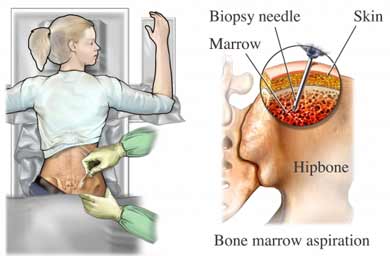
As many of you probably know, the way a blood cancer/disorder is definitively diagnosed is a bone marrow biopsy. si55551694This procedure is generally performed in the clinic, with the patient under light sedation.  When mine was done, my doctor was at a free standing clinic, with no anesthesiologist, or respiratory support available…so unfortunately for me, there was no sedation…just a local in the back of my hip. While laying on my stomach on the table, the doctor sterilized the area he had chosen. After the local had gone to work, the doctor made a very small incision, and inserted the needle. Bone_marrow_biopsy_needle The needle is screwed down into the bone, almost like a corkscrew to open a bottle of wine. After the doctor gets through the bone, they will use a syringe to remove a sample of liquid marrow, then goes a bit deeper with the needle to remove a small solid piece of marrow as well. Aspirating the liquid marrow is pretty painful, which is why there is usually a sedative given to the patient. After the samples have been removed, the doctor or nurse will apply pressure to the wound and then bandage it. There is usually some residual pain after the procedure. I was achy for about 3-4 days afterwards and the results came through about a week or two later.

Tomorrow we will start talking about blood tests and what they mean!

Until tomorrow,

Lina

Blood Cancer Awareness Post 6: Platelets

As I mentioned yesterday in the White Blood Cell post, today we’ll be talking about my personal favorite cell, the platelet! As an E.T patient, platelets hold a special place in my heart 😉

platelets

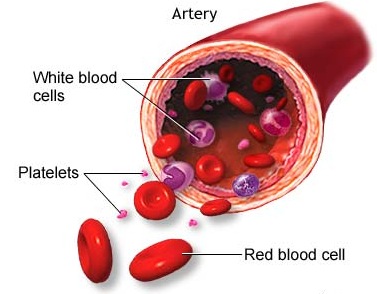
Platelets, or thrombocytes, are really more like fragments of cells (because they lack a nucleus), as opposed to whole cells like WBCs, or RBCs. Platelets help with clotting in the body. When you are injured, platelets rush to the site of injury and form a clot. Preventing excessive bleeding but at the same time, the platelets also secrete chemicals that promote nearby fibroblasts (collagen forming cells) from other tissues to the wound site. This tells the wound to either heal correctly, or to form a scar.

Like all blood cells, a proper number of cells does need to be maintained. Too few platelets can lead to excessive bleeding. Too many platelets can lead to myocardial infarction, pulmonary embolism, stoke  or headaches. Luckily there are treatments for both issues, but we will talk about those more later this month!

Tomorrow we will be talking about bone marrow. So stay tuned!

Until tomorrow,

Lina